Doubling the Impact: GJKS Installs Second Grinding Unit in Village Balua to Meet Soaring Demand

Growth brings new challenges, and the best challenge to have is high demand.

Following the massive success of our first livelihood center, the number of women joining our initiative has grown rapidly. The sheer volume of Sattu, Besan, and spices being produced meant that a single machine could no longer keep up with the ambition of our women entrepreneurs.

GJKS is proud to announce that we have risen to the occasion.

A New Hub in Balua

Today, we successfully installed a second industrial-grade grinding machine, specially procured and transported all the way from Lucknow.

This new unit has been set up in Village Balua (Maniyar-Bandish, Ballia), marking our expansion into a second dedicated facility. This strategic move ensures that women in and around Balua have immediate access to processing facilities without having to travel to the first center.

Running Non-Stop for Success

The machines are a testament to the hard work of the SHG members.
With two centers now fully operational in two different villages, the hum of productivity never stops.
Our machines are currently running for at least 12 hours daily.

From early morning until late evening, these units are processing grains to produce the famous Ballia products that are filling the shelves of our Smart Store and local markets.

Expanding the Circle of Opportunity

With 2 machines in 2 villages, we have effectively doubled our capacity.

  • Reduced Waiting Time: Women no longer have to wait in long queues to process their raw materials.

  • Increased Income: Higher production capacity means more sales and more profit for every household involved.

This second machine is not just a piece of iron and steel brought from Lucknow; it is an engine of hope. It signals that GJKS is scaling up, and we are committed to ensuring that every woman who wants to work has the tools to do so.

One machine started the spark. Two machines are fueling the fire of change.

A Growing Movement: GJKS Inaugurates 10th SHG as Neighboring Villages Call for Change

They say that success makes noise. In the villages of Ballia, the success of GJKS (Gramin Jan Kalyan Samiti) is echoing loud and clear.

We are thrilled to announce a significant organizational milestone: We have officially established our 10th Self-Help Group (SHG).

What started as a small experiment to bring women together has now blossomed into a robust network of ten disciplined, financially literate, and ambitious groups. But the numbers tell only half the story; the real success lies in the trust we have earned.

The Ripple Effect: Villages are Calling Us

In the early days, our volunteers spent weeks convincing households of the benefits of joining an SHG. Today, the tide has turned.

News of the prosperity and independence of our existing members has spread to surrounding areas. We are now receiving invitations from different villages requesting us to come and set up SHGs in their communities. Women from neighboring areas are seeing the transformation in GJKS members—their ability to save, their new businesses, and their confidence—and they want to be part of this change.

This “pull factor” is the greatest validation of our work. It proves that the GJKS model is not just sustainable; it is desirable.

Financial Trust: Unlocking Bank Loans

Creating a group is the first step; empowering them financially is the second.

We are proud to report that our SHGs have achieved a high level of financial discipline, making them eligible for mainstream banking support. Several of our SHGs have successfully secured loans from formal banks.

This is a massive achievement. For a rural woman who previously struggled to open a savings account, receiving a business loan from a bank is a leap toward financial inclusion.

Fueling Micro-Businesses

These loans are not being used for consumption; they are being invested in production. With the capital secured from banks and the skills training provided by GJKS, our members are launching their own micro-businesses, ranging from:

  • Food processing (Sattu, Pickles, Papad)

  • Handicrafts (Incense sticks, Candles)

  • Goat rearing and dairy

  • Retail shops

The bank loans act as the fuel, and the women’s hard work is the engine driving these new ventures.

The Road Ahead

Reaching our 10th SHG is a moment of pride, but the invitations from new villages remind us that our work is far from over. We are committed to honoring these requests and expanding our footprint.

GJKS is no longer just an organization; it is a growing movement of women, by women, and for women.

Bringing the Market Home: GJKS Launches First ‘Hamaragaon Smart Store’ to Boost Rural Livelihoods

Producing high-quality goods is only half the battle; selling them is the other half. For too long, the women of our Self-Help Groups (SHGs) faced a difficult choice: spend their entire day traveling to distant city markets to sell their produce, or sell to middlemen at throwaway prices.

GJKS is proud to announce the solution: The Hamaragaon Smart Store.

We have established our very first retail outlet dedicated exclusively to products made by rural women. This is not just a shop; it is a bridge between the hardworking village producer and the local consumer.

The Smart Store Model: Zero Rent, Maximum Profit

The biggest enemy of a small business is overhead cost. Shop rent, electricity bills, and maintenance often eat up the small profits a rural woman makes.

The Hamaragaon Smart Store changes the rules of the game.

  • Rent-Free: GJKS provides the space entirely free of cost.

  • Direct Sales: Women sell directly to the customer. There are no middlemen taking a cut.

Because the women do not have to pay for the shelf space, every rupee earned from a sale goes directly towards their livelihood and family welfare.

What’s on the Shelves?

The store showcases the best of Ballia, produced fresh by our SHG members using the machinery and training provided by GJKS. Customers can now buy:

  • Authentic Foodstuffs: Freshly ground Bhatti Sattu, pure Besan, and handmade Papads.

  • Household Items: Hand-rolled Incense sticks (Agarbatti) and Candles.

  • Seasonal Produce: Fresh fruits and vegetables from local farms.

By buying from the Hamaragaon Smart Store, the community gets fresh, unadulterated products, and the money stays within the village economy.

A Pilot for a Bigger Vision

This first store is just the beginning. We are treating this as a pilot project to test the market and refine our operations.

Our vision is ambitious: If this model proves successful, GJKS pledges to replicate the Hamaragaon Smart Store in different villages across the district. We envision a network of these stores, creating a decentralized supply chain where rural women are the leaders of commerce.

Shop Local, Change Lives

We invite the community to visit the store and experience the quality of rural craftsmanship. When you shop at Hamaragaon Smart Store, you aren’t just buying a packet of Sattu or a box of incense—you are validating the hard work of a village daughter.

Self Help Groups (SHGs)

What are SHGs?

A self help group is defined as a “self governed, peer controlled information group of people with similar socio-economic background and having a desire to collectively perform common purpose.”

The distinguishing features of self help groups are given below.

(i) SHG usually consists of at least ten people (maximum twenty) with similar economic prospects and social status.
(ii) It promotes goals such as economic improvement and fundraising Development and freedom from exploitation.
iii) It has its own rules for the functioning of the group as well as for Compliance with certain rules by group members and regarding regulations Membership.
iv) Forms of such groups can be largely informal (unregistered).
v) Regular general meetings are held to solve their problems (economy and social) and they collect regular savings from members.
vi) Members’ savings are held in the bank under the name of the group and are authorized. A representative from the group manages the bank account. Deposits are deposited in the bank used to lend the member’s credit for the purpose of including consumption equal to the amount. Interest set by the group (usually higher than the interest charged by the bank).
vii) Sources of money are contributions from member savings, entry fees and interest from loans, income from joint ventures and income from investments.
The funds can be used for loans, social services and general investments.

Need for SHGs

One of the causes of poverty in our rural areas is poor access to credit and financial services.

A committee chaired by Dr. K. Rangaradjan for the preparation of a comprehensive report on “Financial inclusion in the country” identified four main reasons for the lack of financial inclusion:

  • The impossibility of providing collateral,
  • Poor borrowing capacity,
  • The size of the institution is insufficient
  • Weak community network.

The presence of a strong network of rural communities is increasingly recognized as one of the most important elements of credit hubs in rural areas.

They help access credit for the poor and thus play an important role in reducing poverty.

They also help build social capital among the poor, especially women. It empowers women and gives them a bigger voice in society.

Financial independence through self-employment has many external factors such as increased literacy, better health care, and even better family planning.

Benefits of SHGs

Social Integrity – SHG promotes collaborative efforts to combat practices such as dowry, alcoholism and many more.
Gender Equality – SHG empowers women and sees the leadership qualities among them. Women in authority are more actively involved in the Gramm Sabha and elections. In this country, as elsewhere, there is evidence that the formation of self-help groups has a multiplier effect on improving the status of women in society and in the family, leading to an increase in their socioeconomic status and an increase in their self-esteem.
Stakeholders – By participating in the management process, they can highlight issues such as dowry, alcoholism, risk of open defecation, primary health care, etc. and decisions about policy impact.
Voice of the Marginalized Section – Most of the beneficiaries of government programs come from weaker and marginalized communities, therefore their participation through SHG guarantees social justice.
Financial Inclusion – Loan interest rates with priority sectors and rates of return encourage banks to provide loans to SHGs. The SHG-Bank liaison program introduced by NABARD facilitates access to credit and reduces reliance on traditional lenders and other non-institutional sources.
Improve the effectiveness of government systems and reduce corruption through social audits.
Alternative sources of employment – reduce dependence on agriculture by providing support for microenterprise creation, for example personalized business activities such as sewing, grocery store and workshop.
Changes in consumption patterns – Participating households can spend more on education, nutrition and health than non-customer households.
Housing and Health Impacts – Financial inclusion achieved through SHG has resulted in reduced child mortality, improved maternal health and the ability of the poor to fight disease through better nutrition, housing and health – especially among women and children.
Banking Literacy – Encourage and motivate its members to save and act as an official banking service channel to reach them.

Weakness of SHG

  • Group members do not necessarily come from the poorest families.
  • Even though the poor are socially empowered, the economic benefits of qualitative changes in their lives are not satisfactory.
  • Many activities carried out by SHG still rely on primitive skills, especially those related to primary sector companies. Due to low value added per employee and main livelihood, such activities often do not result in a significant increase in group members’ income.
  • In rural areas there is a shortage of qualified staff who can help upgrade skills or acquire new skills from group members. In addition, there are no institutional mechanisms for capacity building and skills training.
  • Bad accounting practices and cases of misuse of funds.
  • Lack of resources and funds to place the goods.
  • SHGs rely heavily on government agencies that sponsor them. The withdrawal of support often causes their damage.

STEPS TO ACHIEVE SHG EFFECTIVENESS

The government must act as a facilitator and organizer and create a supportive environment for the growth and development of the SHG movement.

Expansion of the SHG movement to areas with a credit deficit – such as Madhya Pradesh, Rajasthan, states in the Northeast.

Rapid expansion of financial infrastructure (including NABARD) and introduction of extensive communication and capacity building measures in these countries.

Developing Support Groups in Urban / Suburban Areas – Efforts should be made to increase the capacity of the urban poor as urbanization increases rapidly and many people remain financially isolated.

Positive Attitude – Officials must treat the poor and marginalized as worthy and responsible customers and aspiring entrepreneurs.

Surveillance – the need to have separate SHG surveillance cells in each country. The cell must have a direct connection to an area and a block level surveillance system. Cells must collect both quantitative and qualitative information.

Demand-oriented approach – commercial banks and NABARD, in collaboration with state governments, must continue to develop and innovate new financial products for this group.

COVID-19 Relief Package Distribution

Ration Kit – To Daily Wagers (Affected due to Covid19 pandemic lock-down)

GJKS a non-profit organisation based in Ballia,India .Our team’s mission is simple – no one should have to sleep hungry.

With extended lock down in place due to COVID-19 daily wage earners like labourers, carpenters, plumbers, sanitary workers, maid, servants, construction workers, Rickshaw-pullers, hawkers etc. have been hit hard. They can’t work and also they don’t have any saving to buy essentials and food. We need to extend to our support to fight corona on economic front.

The thousands of labourers who reached their home couple of days ago in U.P. & Bihar from Maharashtra and Gujarat poses serious risk of spreading virus in villages. We already have been asking those came from outside to stay at home. 

Immediately required essentials 

Foods

The labourers usually go to city in the morning to earn money and by evening they come back. Whatever they earn in a day usually spend for buying essentials. We must deliver essentials in our capability to help them stay home to contain virus.

Medicine/Sanitizers/Awareness

With delivery of essentials our volunteers will also tell them to maintain social distancing, proper hygiene as well as aware others about the virus. Soaps are essential commodities to maintain hygiene and check virus. Also, if anyone found to be have symptoms of CORONA local authorities will be informed.

Money Raised will be used to

• Provide grocery sufficient for 2-3 weeks, so that they stay at home and help India fight CORONA

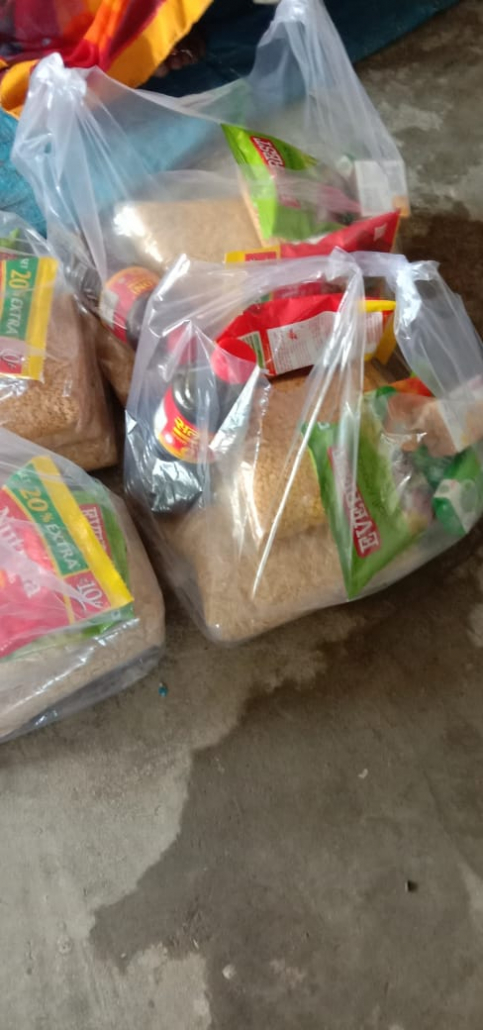
• Grocery will contain 5 kg of rice, 10 kg of Wheat Flour, 2 kg of pulses, oil, sugar, soaps etc. 

• Masks will be provided to families whose any member has cold/cough.

Way of operation: 

We will procure essentials from whole sellers and deliver it to needy people village by village. We are well aware of possibility of virus spread and for that we already have trained our volunteers to spread awareness and take precautions along with maintaining social distance.

With your help and contribution we will make India CORONA free.

Food Distribution Started

We are glad to share that while we are waiting for the funds to get reflected with us, we have already started procuring food products (thanks to  donors )

Here are some updates regarding food donations.

We are still working on ensuring that people follow social distancing while coming to take the food packs and while we struggled with that in the beginning (people were eager to get rations), we are slowly getting there.

Donate :-https://gjks.in/donate/